
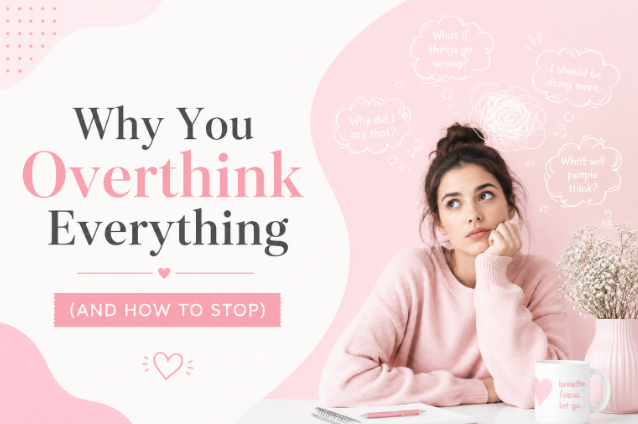
You lie in bed at night. The meeting is over. The conversation happened hours ago. But your brain is still replaying it.
What did they mean by that? Should I have said something different? What if it goes wrong tomorrow?
This is overthinking. And if you do this regularly, you are not alone. Millions of people in India experience it every single day. But here is what most people do not know: overthinking is not a personality flaw. It is a symptom. And like every symptom, it has a root cause.
This article explains why you overthink, what it is doing to your mental and physical health, and most importantly, what actually works to stop it.
What Is Overthinking?
Overthinking is the habit of getting stuck in repetitive, circular thought patterns that go nowhere. You are not solving a problem. You are spinning on one.
There are two main forms:
Rumination: replaying the past. Dwelling on mistakes, regrets, and things said or unsaid.
Worry: projecting into the future. Imagining worst-case scenarios that have not happened yet.
Both feel productive. Neither is. Overthinking creates the illusion of thinking through a problem while actually preventing you from resolving it.
Why Do You Overthink? The Real Reason
Most people assume they overthink because they are “just wired that way.” The truth is more specific and more hopeful than that.
Your brain has a threat-detection system called the amygdala. When it perceives danger, it triggers a stress response. This system was designed for physical threats like a predator or a fall. But in modern life, your brain treats social threats, uncertain outcomes, and unresolved conflicts the same way.
Overthinking is your nervous system trying to protect you by scanning for every possible danger before it strikes.
Here is why that matters: if your nervous system is in a chronic state of alert, your brain will not stop scanning. No amount of telling yourself to “just relax” will override a nervous system that believes it needs to stay on guard.
This is why overthinking is so closely linked to anxiety.
The Connection Between Overthinking and Anxiety
Overthinking and anxiety feed each other in a loop.
Anxiety makes your brain hypervigilant. A hypervigilant brain notices more potential threats. More perceived threats generate more anxious thoughts. More anxious thoughts reinforce the anxiety. And the loop continues.
Research consistently shows that chronic overthinking is one of the strongest predictors of anxiety disorders and depression. A 2013 study published in the Journal of Abnormal Psychology found that repetitive negative thinking is a transdiagnostic risk factor, meaning it shows up across multiple mental health conditions, not just anxiety.
This is important because it tells us that to truly stop overthinking, you cannot just target the thoughts. You have to address the anxiety underneath them.
What Overthinking Is Doing to Your Body
Overthinking is not just a mental experience. It has physical consequences.
Chronic overthinking keeps your body in a state of low-grade stress. Cortisol, the stress hormone, stays elevated. Over time, this can lead to:
Disrupted sleep Digestive issues Lowered immunity Muscle tension and headaches Fatigue even after rest Increased blood pressure
Your body does not distinguish between a real threat and a thought about a threat. Every time your mind catastrophises, your body responds as if the worst-case scenario is actually happening. This is why people who overthink often feel physically exhausted. The mental loop is physically taxing.
Common Triggers for Overthinking
While overthinking can happen to anyone, certain situations tend to activate it more consistently.
Uncertainty and waiting for outcomes Relationship conflict or ambiguity Work performance and fear of judgment Past trauma or unresolved emotional experiences Low self-esteem and fear of making the wrong decision Perfectionism
Notice something about this list. Many of these triggers are rooted in something deeper than just “stress.” They often connect back to core beliefs about safety, worthiness, and control. Beliefs that were usually formed much earlier in life.
This is a key insight that shapes how effective therapy for anxiety actually works.
Why Willpower Alone Does Not Stop Overthinking
You have probably tried telling yourself to stop. It does not work. Not for long.
That is because overthinking is not a conscious choice. It is a conditioned pattern, often rooted in the subconscious mind. Your conscious mind can recognise that a thought is irrational. But the subconscious, which drives 90 to 95 percent of your behaviour and emotional responses, does not respond to logical instructions.
This is why approaches that only work at the level of conscious thinking have limited effectiveness for chronic overthinking and anxiety. You need something that reaches the root.
Anxiety Treatment Without Medication: What Are Your Options?
Many people seek anxiety treatment without medication. Not because medication is wrong, but because they want to address the root cause of their anxiety rather than manage symptoms.
There are several evidence-informed approaches:
Cognitive Behavioural Therapy (CBT): Helps you identify and restructure negative thought patterns. Highly effective for mild to moderate anxiety.
Mindfulness-Based Stress Reduction (MBSR): Trains awareness of thought without identification or reaction. Builds the capacity to observe overthinking without being controlled by it.
Somatic Therapy: Works with the body’s response to stress. Effective when anxiety is held physically as tension, breathlessness, or hyperarousal.
Psychotherapy and Counselling: Provides a structured space to explore the emotional and relational roots of anxiety.
Rapid Transformational Therapy (RTT): Works at the subconscious level to identify and reframe the root beliefs that drive anxiety and overthinking. Often produces significant shifts in fewer sessions than traditional talk therapy.
Each approach has its strengths. The right fit depends on your history, symptoms, and what you are ready to engage with.
What Is Rapid Transformational Therapy (RTT)?

Rapid Transformational Therapy was developed by world-renowned therapist Marisa Peer. It is a hybrid methodology that draws from hypnotherapy, CBT, neuro-linguistic programming (NLP), and psychotherapy.
RTT works by accessing the subconscious mind in a relaxed, focused state similar to guided meditation. In this state, the therapist helps you locate the specific experiences and beliefs that formed the pattern you are now experiencing, whether that is chronic anxiety, overthinking, low self-esteem, or fear.
Once those root causes are identified, RTT uses evidence-based techniques to update and reframe those beliefs at the subconscious level. A personalised recording is then created for the client to listen to over 21 days, reinforcing the transformation.
Why 21 days? Because that is approximately how long neuroscience suggests the brain needs to form and solidify new neural pathways.
RTT is not about talking through problems indefinitely. It is about locating the source and resolving it efficiently.
RTT for Anxiety and Overthinking: What to Expect
For someone dealing with anxiety and chronic overthinking, an RTT session typically involves:
An in-depth intake conversation to understand your history, patterns, and goals. A guided regression to identify the experiences that originally created your current beliefs about safety, control, or worthiness. Reframing work to update those beliefs with accurate, empowering interpretations. A personalised transformation recording to listen to daily for 21 days.
Many clients report noticeable shifts after just one to three sessions. Some describe feeling a sense of mental quiet that they have not experienced in years. Others notice that situations which previously triggered a spiral no longer hold the same charge.
This is the difference between managing anxiety and resolving the root of it.
Meet Varsha Patkar: Psychologist, Counsellor and Rapid Transformational Therapist in Mumbai

Varsha Patkar is a qualified psychologist, counsellor, and certified Rapid Transformational Therapist based in Mumbai. She works with clients who are dealing with anxiety, overthinking, burnout, self-doubt, relationship stress, and other challenges that are impacting the quality of their daily lives.
Varsha’s approach is integrative. She does not believe in a one-size-fits-all model. Depending on your needs and readiness, she draws on psychotherapy, counselling, and RTT to create a personalised path forward.
Her clients are people who have often tried other approaches without lasting results. They come to her when they are ready to go deeper and actually understand why they think and feel the way they do.
If you are in Mumbai and looking for therapy for anxiety or a way to genuinely stop overthinking, working with a trained professional who combines traditional psychology with RTT offers a powerful and lasting alternative to medication or generic self-help strategies.
You can learn more and book a session with today
Recent Comments